What Small Businesses Actually Need in an AI Receptionist
Discover the 7 features that make an AI receptionist worth it for small businesses, from missed call recovery to after-hours booking and real ROI.
Every missed call is a missed paycheck. For small business owners, especially in service industries, that ringing phone you could not get to might have been someone ready to book a job, hand over their credit card, and become a loyal customer. It just went to your competitor instead.
Here is the thing: most small businesses are already using AI in some form, but very few are using it where it matters most. An ai receptionist for small business is one of the smartest and most practical places to start, because it solves a real problem you feel every single day.
In this post, we are breaking down exactly what to look for when choosing an AI receptionist, and more importantly, what it needs to actually do to earn its place in your business. From handling calls at 2 a.m. to routing urgent jobs and connecting with the scheduling tools you already use, we are covering it all. We will even show you how to measure whether it is working. No tech background required, just a willingness to stop missing calls.
The Real Cost of a Missed Call (It Is Not Just One Job)
Let's start with a number that should bother you.
For HVAC and plumbing companies, each missed call can represent $800 to $1,200 in lost revenue, and that adds up to $98,000–$156,000 or more annually. That's before you factor in repeat customers or the referrals they would have sent your way. If you want to understand how much your unanswered phone is actually costing you, the numbers are harder to ignore than most owners expect.
The timing makes it worse. Most missed calls happen after hours, on weekends, or right when you're already knee-deep in a job. Those are exactly the moments customers are calling with something urgent. They're not browsing. They need help now.
And here's what happens when they reach voicemail: research consistently shows 85% of callers who reach voicemail never call back, they move on to the next option.
Meanwhile, 68% of small businesses now use AI regularly. Some of your competitors may already be answering the calls you're sending to voicemail.
The math to justify an AI receptionist is straightforward. Take your average job value and multiply it by how many calls you estimate you miss each week. That number is what inaction actually costs. Everything else in this guide builds from there.
24/7 Availability That Does Not Require Hiring Anyone
Home emergencies don't follow business hours, the call that matters most often comes at 11pm on a Saturday.
The fix isn't hiring a night-shift receptionist. It's choosing an AI receptionist that operates without supervision, around the clock, every day of the year.
What to actually look for here: Not all "24/7" solutions are equal. Some just play a hold message or collect a callback number. That's not coverage, that's a fancier voicemail. You need a system that can answer the call, ask the right questions, and book the appointment, all without anyone on your team lifting a finger.
Customer service automation consistently delivers measurable time savings within weeks, faster than almost any other AI use case. After-hours call coverage is where that ROI shows up fastest, because every captured call is a dollar-denominated result you can track immediately.
A significant share of revenue-generating calls come outside normal business hours, one analysis of 40 service businesses found 40–60% fell outside the 9–5 window. Virtual Dispatcher answers every inbound call 24/7, gives callers a professional response, and books appointments directly into your schedule. The deeper breakdown of why home service businesses can't afford to miss calls is worth a read.
One more thing to verify before you commit: call volume caps. During a winter storm or a heat wave, call volume can spike dramatically. Confirm upfront that the solution handles high-volume periods without additional charges, contract terms vary significantly by vendor.
Automatic Lead Qualification Before the Job Hits Your Calendar
Answering every call is only half the job. The other half is making sure the calls you answer are actually worth booking.
Only 35% of calls from digital marketing are genuinely qualified leads, which means a significant chunk of your inbound volume is noise. Without a filter, that noise lands on your technicians' schedules as wasted drive time and missed revenue opportunities elsewhere.
A good AI receptionist should ask qualifying questions before anything gets booked: Where are you located? What type of service do you need? How urgent is the situation? Those three questions alone separate a same-day emergency from a next-week estimate call.
The distinction matters more than it sounds. A 24/7 answering service that simply picks up and takes a message doesn't sort those categories, which means your calendar fills up with unqualified bookings that inflate your booking rate without improving actual revenue.
When evaluating any AI receptionist, ask the vendor one direct question: what percentage of calls result in correctly categorized outcomes? Qualification accuracy is a real, measurable metric, and any vendor worth considering should be able to answer it by service type and urgency tier, not just as a blanket number.
Virtual Dispatcher handles this automatically. It uses conversational prompts to screen every caller for service type, location, and urgency before anything touches your schedule. By the time a job appears on your calendar, it has already been filtered. You get fewer wasted dispatches and a booking list that reflects real, actionable demand.
Urgent Call Routing That Knows the Difference Between a Drip and a Burst Pipe
Qualification filters the routine calls. But what happens when someone calls in a panic because water is pouring through their ceiling?
Not every emergency caller uses the word "emergency." Someone with a burst pipe might just say "it's really bad" or "water is everywhere." A good AI receptionist has to catch those signals and act on them immediately, routing the call to an on-call tech or owner rather than dropping it into a standard Tuesday afternoon booking slot.
This is where a lot of AI tools fall short, and where the stakes are highest. A gas leak, a flooded basement, or a heating system failure in January is a liability situation, not a scheduling puzzle.
There's also a governance angle worth taking seriously. 77% of small businesses using AI have no written AI policy, and undefined escalation paths are one of the most common gaps. If your AI misroutes an emergency call and no one catches it, the question of who is accountable gets complicated fast.
When you're evaluating any AI receptionist, ask the vendor one direct question: how does your system detect an emergency? Some tools rely on keyword triggers like "flood" or "leak." Others use contextual analysis to read urgency from tone and phrasing. A few still expect the caller to self-identify, which is the least reliable method when someone is panicking.
It's also worth reading what callers actually experience with an AI receptionist before you commit, because how the system sounds in a high-stress moment matters.
Virtual Dispatcher routes urgent calls automatically based on the nature of the request, so a critical situation reaches a real person right away instead of sitting in a queue until morning.
Integration With the Scheduling and Dispatch Tools You Already Use
Routing the right calls to the right people only pays off if the booking lands cleanly in your system. That's where integration becomes the next critical question.
Integration debt is a hidden cost that catches many small businesses off guard. If your AI receptionist can't connect directly to your scheduling software, someone still has to manually transfer every booking. That step costs time, introduces errors, and quietly erodes the efficiency you paid for.
The average small business spends $2,400 per year on AI tools, and poor integration can add to that cost through staff time spent on data entry and fixing mistakes. A tool that looks affordable on a pricing page becomes expensive once you factor in hours spent bridging the gap between systems.
Look for native integrations with the scheduling tools, dispatch platforms, and CRM systems you already use. Third-party connectors can work, but they require ongoing maintenance and tend to break at the worst moments.
A clean integration looks like this: a caller books a job, that appointment flows directly into your dispatch workflow, your technician gets the job details automatically, and the customer receives a confirmation. Nobody touches a keyboard. Virtual Dispatcher is built with this workflow in mind, specifically for home service businesses where that end-to-end flow directly translates to revenue.
Before you sign up for anything, map out your current software stack. Then ask the vendor to walk you through exactly how data moves from an inbound call to a confirmed appointment inside your system. If they can't answer that clearly, that's your answer. For a deeper look at how different tools handle this, best AI answering services for plumbers and HVAC companies breaks it down side by side.

How to Measure Whether Your AI Receptionist Is Actually Working
Once your integration is solid, the next question is simple: is this thing actually making you money?
Here's good news specific to AI receptionists: you don't have to wait the 3 to 6 months that most AI tools need before showing real ROI. Every booked appointment is a dollar-denominated event you can track immediately. Results show up fast.
The four numbers worth watching from day one:
Missed call recovery rate: What percentage of calls that previously went to voicemail are now getting answered and converted?
After-hours appointment capture rate: How many jobs are being booked outside your normal business hours?
Lead qualification accuracy: Are the calls hitting your calendar actually the right service type, right location, right urgency level?
Average response time: Is every caller getting an immediate answer, or are there delays?
Give yourself a 90-day measurement baseline before you think about expanding AI into any other part of your business. Research consistently shows that phased adoption with defined measurement cycles outperforms all-at-once rollouts. Ninety days gives you enough call volume to spot real patterns, not just a good week.
During that first quarter, track the job value from AI-booked appointments separately from jobs your team books manually. Comparing revenue per channel tells you exactly what the tool is worth in dollars, not just impressions.
Finally, ask your vendor to show you call logs, booking outcomes, and escalation reports. If they can't, that's a red flag. Everything your front phone line needs should include full visibility into performance, not just a polished demo.
Data Security and Call Handling Policies You Can Actually Stand Behind
Performance visibility matters, but it only tells half the story. The other half is what happens to the data your AI receptionist collects on every single call.
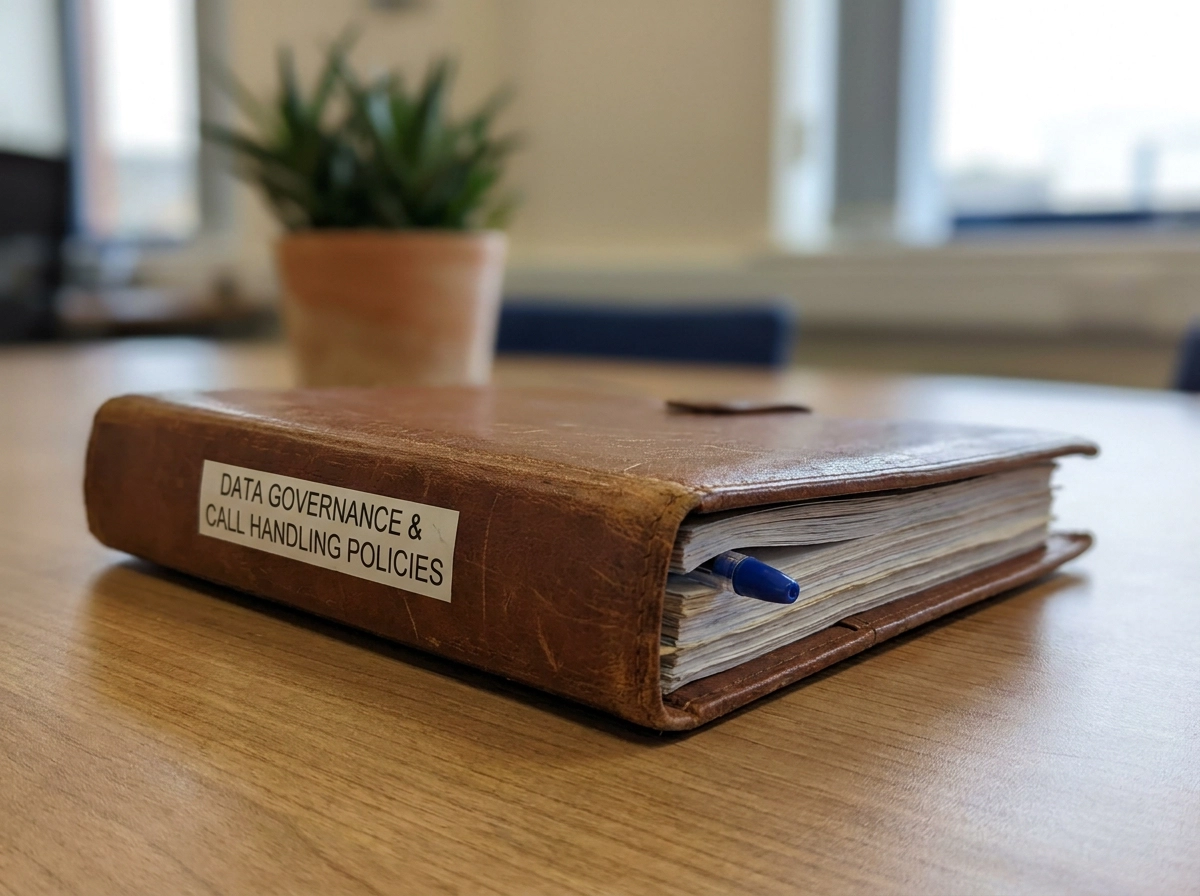
That governance gap extends to data handling too, the same absence of written policy that leaves emergency routing undefined also leaves customer call data unprotected.
Every call your AI receptionist handles involves personally identifiable information. Before committing to any vendor, ask these questions directly:
Where is call data stored, and is it encrypted?
How long are recordings retained, and who can access them?
Who reviews flagged calls or errors, and how are mistakes documented?
If a vendor cannot answer those questions clearly, that is a red flag equal to any gap in their reporting dashboard.
A basic written policy does not require a legal team. It just needs to define four things: how data is stored, how long recordings are kept, who reviews escalated or flagged calls, and what the correction process looks like when the AI mishandles something. States like California have already moved toward formal AI and privacy governance requirements, and federal frameworks are following.
There is also a customer trust dimension here. A homeowner calling about a flooded basement or a furnace failure is sharing personal information under stress. How you handle that data reflects on your business, not just your vendor.
Virtual Dispatcher is built specifically for home service companies, giving owners straightforward visibility into how calls are handled and stored without needing to decode legal fine print.
The Bottom Line: Start With One Tool, Measure for 90 Days
Once you have your data governance policies in place, you are ready to make a final call on where to start.
An AI receptionist is the single highest-ROI entry point for small business AI adoption because it attacks a problem every home service company already has: the missed call. Every unanswered ring is a lead that does not wait around. For HVAC and plumbing companies, each missed call can represent $800 to $1,200 in lost revenue, and those losses accumulate quickly across a week or a season.
When you evaluate any solution, run it against these seven capabilities:
24/7 availability with no call volume caps
Lead qualification before anything hits your calendar
Urgent call routing for emergencies that cannot wait
Scheduling integration so bookings flow directly to dispatch
Performance reporting with call logs and booking outcomes
Data governance with clear retention and access policies
Transparent pricing with no surprise overage fees
The 90-day measurement framework described earlier gives you the data to make a confident decision about what comes next.
Virtual Dispatcher is built specifically for home service businesses like plumbing and HVAC companies. It answers every inbound call around the clock, qualifies callers, books appointments, and routes emergencies to a real person automatically. No voicemail. No missed leads.
The monthly cost of a good AI receptionist is a fraction of a single missed emergency job. The math is simple. The risk of doing nothing just keeps growing.
Conclusion
Every missed call is a missed paycheck, and the problem compounds every day you leave it unsolved. The right AI receptionist does not replace your team; it fills the gaps your team cannot cover: nights, weekends, and the moment two phones ring at once.
The core case is simple: 24/7 availability, smart qualification, seamless integration, and a 90-day measurement window. Everything else follows from those four fundamentals.
Start today. Choose one solution, measure your missed call recovery rate, and let the numbers guide your next move. The businesses that act now will be the ones competitors are trying to catch up with a year from now.