
What an AI Receptionist Actually Does on a Home Service Call (Step by Step)
AI receptionist for home service businesses answers calls 24/7, qualifies leads, and books appointments automatically without missing a single ring.
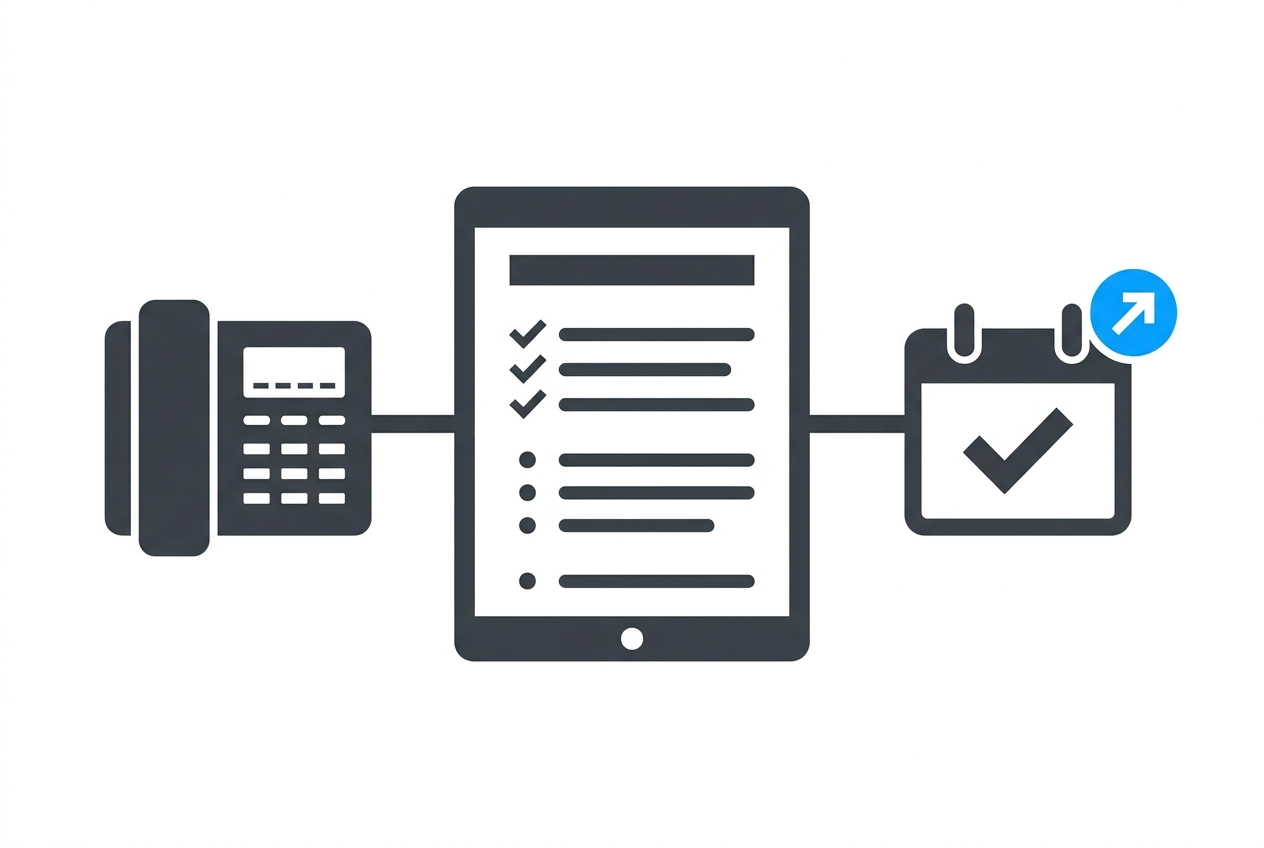
It's 11 PM on a Tuesday. A pipe just burst under someone's kitchen sink, and they're scrambling to find an emergency plumber. They call the first number they find. What happens next determines whether that job goes to you or your competitor.
If no one answers, they move on. It's that simple.
This is where an AI receptionist for small business owners becomes a genuine game changer, and not in the buzzword kind of way. We're talking about a real, friendly-sounding conversation that greets the caller, figures out what they need, asks the right questions, and locks in a booking, all without you lifting a finger.
Most people hear "AI receptionist" and picture one of those frustrating phone trees where you're pressing 1 for this and 2 for that. This is nothing like that.
In this post, we're going to walk through exactly what happens on an AI-handled call from the very first ring to a confirmed appointment. You'll see the real conversation flow, learn how job qualification works, and understand why this technology is quietly becoming essential for home service businesses.
Why Missing Calls Costs Home Service Businesses More Than They Realize
Every missed call is a missed paycheck. Small and medium-sized businesses miss an estimated 25% to 60% of their inbound calls, and for a plumbing or HVAC company, each one of those unanswered rings represents a homeowner with a real problem and money ready to spend.
The situation gets worse when you factor in what happens after the call drops. Research suggests that 85% of callers who reach voicemail never call back. They move on, usually to whoever picks up next. So each missed call is not just a delay; it is a permanent loss.
Add it up over a year, and industry estimates put the average home service company's missed-call revenue loss at roughly $126,360. That is not a rounding error. That is a second technician's salary walking out the door.
The problem hits hardest after hours. Burst pipes and failed furnaces do not wait until Monday morning. When a homeowner's heat goes out at 9 PM on a Saturday, they need help immediately. If your phone goes to voicemail, every missed call could be your competitor's next job.
Hiring a full-time receptionist seems like the obvious fix, but at roughly $2,000 per month before benefits, it is expensive and still leaves gaps. Nobody works every evening, every weekend, every holiday.
An AI phone receptionist solves this without adding headcount. It answers every incoming call the moment it arrives, around the clock, and starts converting that call into a booked job right away.
An AI Receptionist Is Not a Phone Tree -- Here Is the Difference
So now you know the cost. The next question most business owners ask is: "Can't I just set up a phone menu for that?"
Not quite. A traditional IVR (the system that says "Press 1 for scheduling, press 2 for billing") forces every caller down a fixed path. It cannot understand plain speech, it cannot adapt, and it cannot tell the difference between a routine question and a genuine emergency. Callers either find their option or they hang up.
An AI virtual receptionist works nothing like that. The AI listens, identifies what the caller needs, applies your business rules, and delivers a concrete outcome, booking, transfer, or callback. The caller never sees any of that. They just experience a helpful, responsive voice that understands them.
The system also handles real-world messiness. If a caller interrupts, changes their mind, or asks a follow-up question mid-sentence, the AI adjusts. A phone tree cannot do any of those things.
For home service businesses, this distinction matters. A caller saying "my furnace stopped working and the house is getting cold" signals urgency. A caller saying "I want to schedule routine maintenance" does not. An AI phone receptionist recognizes that difference, routing each call based on what was actually said, not which button was pressed.
You can browse more on topics like this across the Popular Categories on the Virtual Dispatcher blog.
A Real Call Walkthrough: Emergency Plumbing Call at 11 PM
Here is what that looks like in a real call.
It is 11 PM on a Tuesday. A homeowner notices water dripping through the kitchen ceiling. They call the first plumber in their contacts. The office is closed and under normal circumstances that call goes straight to voicemail.
With Virtual Dispatcher, it does not.
Step 1: The greeting. The AI answers promptly. The caller hears: "Thanks for calling Riverside Plumbing, this is the virtual receptionist. How can I help you tonight?" It sounds like a person picked up, not a recording. That first impression matters to someone in a panic.
Step 2: Intent recognition. The caller says, "I have water coming through my ceiling." The AI flags the call as an emergency immediately and shifts out of the standard booking flow.
Step 3: Context capture. The AI asks exactly what a dispatcher would: the caller's address, what they can see, whether water is still flowing. Targeted questions, nothing unnecessary.
Step 4: Business rule application. Because the job is flagged urgent, the after-hours emergency protocol activates instead of the routine booking path.
Step 5: Action execution. Depending on account configuration, the AI either warm-transfers the caller to the on-call technician, books an emergency slot directly, or sends an alert to the dispatcher with every captured detail.
Step 6: Structured outcome. The call closes with clarity. The caller knows a technician is on the way, or a callback is confirmed within a specific window. No voicemail, no uncertainty. If you want to see how many calls like this your business is currently missing, the Virtual Dispatcher revenue leak audit gives you a fast, concrete answer.
What the Conversation Actually Sounds Like
Here is how that same 11 PM call plays out:
Virtual Dispatcher: "Thanks for calling Riverside Plumbing, this is the virtual receptionist. How can I help you tonight?"
Caller: "Hi, I have a burst pipe and water is everywhere."

Virtual Dispatcher: "I'm sorry to hear that. Let's get someone out to you quickly. Can I get your address and confirm whether the main water valve is accessible so our technician is prepared?"
No pause. No menu. No "your call is important to us." The AI moves straight from empathy into the practical questions a dispatcher would ask, because that is exactly what a panicked caller needs.
When the caller asks "Do you have someone available tonight?", the AI does not dodge it. It gives a direct answer based on the company's actual availability rules, whether that is confirming an emergency slot or setting an honest expectation about timing.
The call closes like a real conversation, not a transaction:
Virtual Dispatcher: "I have an emergency slot available and I'm going to send a technician to you. You'll get a text confirmation in the next few minutes with the technician's name and estimated arrival."
The tone stays calm and specific throughout. That combination, reassurance plus concrete next steps, is what a distressed caller at 11 PM actually needs. It also shapes how they feel about the business long after the repair is done. Ready to stop losing calls?
How an AI Receptionist Qualifies a Home Service Job During the Call
That conversation you just read shows the what of a call. Here is the why it works so well: the AI is quietly doing a job that most small shops leave to chance, which is qualifying the lead before anyone rolls a truck.
Qualification is where real dispatch efficiency is won or lost. When a technician leaves the shop already knowing what they are walking into, the job goes faster, parts are more likely to be on the van, and the customer experience improves immediately.
For HVAC calls, Virtual Dispatcher might ask about the system type, its approximate age, and the specific symptom the caller is describing. That information is captured before the booking is confirmed, not scribbled on a notepad during a rushed morning huddle.
For plumbing calls, the AI might ask where in the home the problem is located and whether the situation is active or slower-moving. Each answer changes how urgent the dispatch is.
All of that goes directly into the booking record, depending on your setup. The technician sees it before departure, not after arrival.
Qualification also works as a filter. If a caller is outside the service area or needs work outside the company's scope, the AI flags it early, preventing a costly, unprofitable roll-out.
For a five-person plumbing company, this is significant. Every single call produces the same structured intake that a large operation with a full office team would expect as standard practice.
What the Technician Sees When the AI Hands Off the Call
All of that qualification data the AI just captured doesn't sit in a vacuum. It moves instantly to the person who needs it most.
When Virtual Dispatcher transfers a call, the receiving technician isn't walking in blind. The technician already has the caller's key details and job context before the conversation begins. There's no "so, what's going on?" moment. That question is a signal of a broken process, and a warm transfer eliminates it entirely.
At the same time, appointment details are logged automatically so nothing needs to be re-entered by hand, and nothing gets lost in translation between a call and a calendar.
For after-hours emergencies, depending on configuration, an alert goes to the on-call technician the moment a booking is confirmed, with the full intake summary attached. No one has to check a queue or refresh a dashboard.
For non-urgent calls, the customer receives a text confirmation once the appointment is locked in, which can help reduce no-shows and cut down on "just checking on my appointment" callbacks.
The result is straightforward: every technician starts each job with a complete intake record, not a sticky note, not a half-remembered voicemail, not a vague description passed through two people. If capturing leads more reliably is the goal, the handoff is where the system proves its value end to end.
When the AI Escalates to a Human (and How It Handles the Handoff)
Smooth handoffs to technicians are only part of the picture. Equally important is what happens when a call goes somewhere the AI shouldn't try to handle alone.
A well-configured AI phone receptionist knows its limits. When a caller expresses frustration or anger, asks directly to speak with a person, raises a situation outside the system's programmed business rules, or presents an edge case the AI can't confidently resolve, it escalates. Every time. Predictably.
What it does not do is abruptly drop the caller or loop them through the same response twice. Instead, it bridges the moment with something like: "I want to make sure you get the right help. Let me connect you with someone directly. Can I put you on a brief hold?" The caller feels heard, not stuck.
If no one is available for a live transfer, the AI captures the caller's name and number, sets a clear expectation ("Someone will call you back within the hour"), and logs the full escalation with context intact. No details fall through the cracks.
This is the practical difference between a real AI virtual receptionist and a frustrating chatbot. A chatbot loops. A well-designed automated receptionist hands off gracefully, because it knows what it does not know.
Business owners can review call logs to see exactly when escalations happened and why. That visibility creates a feedback loop, helping identify gaps in the AI's coverage and tighten its responses over time.
After-Hours and Weekend Coverage: Where the AI Pays for Itself
Escalation handles the edge cases. But the bigger, quieter revenue drain happens every night and weekend, when emergencies hit and no one picks up at all.
Burst pipes don't wait until Monday. Furnaces fail on the coldest Friday night of the year. AC units quit on Saturday afternoon in July. Without coverage, these calls end one of three ways: the caller hangs up, leaves a voicemail that sits until morning, or calls another company that actually answers.
That last option stings most, because that job was yours to lose.
As noted, a caller who hits voicemail almost never tries again.
After-hours behavior is configurable separately from business-hours behavior. Emergency calls, like active leaks or a failed furnace in winter, route directly to your on-call technician. Routine inquiries, like scheduling a maintenance visit, get booked for the next available slot. The system sorts it automatically so your technician isn't woken up for a non-urgent callback.
Virtual Dispatcher is built specifically for this gap, providing 24/7 call answering for plumbing and HVAC companies so every caller gets an immediate response. To see how that translates to real revenue, explore business growth strategies for home service contractors or browse real-world case studies from companies already capturing these calls.
The Bottom Line: Every Call Is a Revenue Opportunity
Everything covered in this walkthrough is already running in real businesses today. This is not emerging technology you are waiting on; it is a practical tool that answers calls, asks the right questions, and books jobs without anyone sitting at a desk.
That flow runs on every call, at noon or midnight, without anyone managing it.
For plumbing and HVAC companies, that translates directly to fewer missed calls, more confirmed appointments, and a stronger first impression with every caller.
Virtual Dispatcher brings this exact call flow to home service businesses, with 24/7 answering, emergency routing, and appointment booking built in from the start. It handles the calls your team cannot get to, whether that is during a busy afternoon or a Sunday night pipe emergency.
If the scenarios in this walkthrough sound familiar, the fix is straightforward. The calls are coming in. The only question is whether your business is the one answering them.
Conclusion
Home service businesses lose revenue one unanswered call at a time. This walkthrough showed exactly how an AI receptionist closes that gap: greeting callers naturally, qualifying the job during the conversation, booking appointments automatically, and handing off clean job details to your technician before the call even ends.
The call flow in this walkthrough is already running in businesses like yours, and every ring your team misses is a job that won't wait.
If your phones are going unanswered right now, that changes today. Visit Virtual Dispatcher to see the full call flow in action and start turning every incoming ring into a confirmed, revenue-generating appointment.