Why a 24/7 Answering Service Isn't Enough for Home Service Businesses
Missed calls costing you jobs? Learn why 26% of home service calls go unanswered and how intelligent call handling converts callers into booked
You answered the phone. You even paid for someone to answer it around the clock. So why are jobs still slipping through the cracks?
For home service businesses, a ringing phone is rarely just a conversation. It is a service call, a booked appointment, and in many cases, a customer relationship that lasts years. Yet industry data shows that roughly 26% of calls to home service companies go unanswered, and nearly two-thirds of callers never connect with a live person at all. When a single missed call can represent hundreds or even thousands of dollars in lost revenue, those numbers are not a minor inconvenience. They are a structural problem.
Here is the part most business owners miss: a traditional answering service addresses only one piece of that problem. Availability alone does not qualify leads, book appointments, or route urgent jobs to the right technician. The gap between picking up the phone and actually converting that caller into confirmed work is where revenue quietly disappears.
This analysis breaks down exactly where those gaps exist, what intelligent call handling looks like in practice, and how to calculate what the difference is actually costing your business.
The Missed Call Problem Is Bigger Than You Think
Around 26% of calls to home service businesses go unanswered, and some call monitoring studies put actual answer rates as low as 37%, meaning nearly two-thirds of callers never reach a person. In retail, a missed call is a minor inconvenience. In home services, it is a missed HVAC installation, a plumbing repair, or a job worth $800 to $1,500 walking straight to a competitor.
The abandonment data makes the stakes even clearer. Roughly 85% of callers who do not get through on the first attempt will not call back. They do not leave a voicemail, wait for a callback, or try again tomorrow. They dial the next company on the list. Understanding why voicemail is costing home service businesses jobs reveals just how quickly that window closes, and how little it takes for a customer to move on.
Many business owners who have invested in a 24/7 answering service believe this problem is solved. The phone gets answered around the clock, so the missed-call issue must be handled. That assumption is expensive.
Call answer rates are only one part of the revenue equation. A call that gets picked up is not a booked job. It is an opportunity, and that opportunity can still be lost in the seconds and minutes that follow. The real question is not whether the phone gets answered; it is what happens to the caller once they connect, and whether that interaction actually moves them toward a confirmed appointment.
That distinction, between availability and conversion, is where most answering-service setups silently fail.
What a Traditional Answering Service Actually Does
So the phone gets answered. That's the job done, right? Not quite.
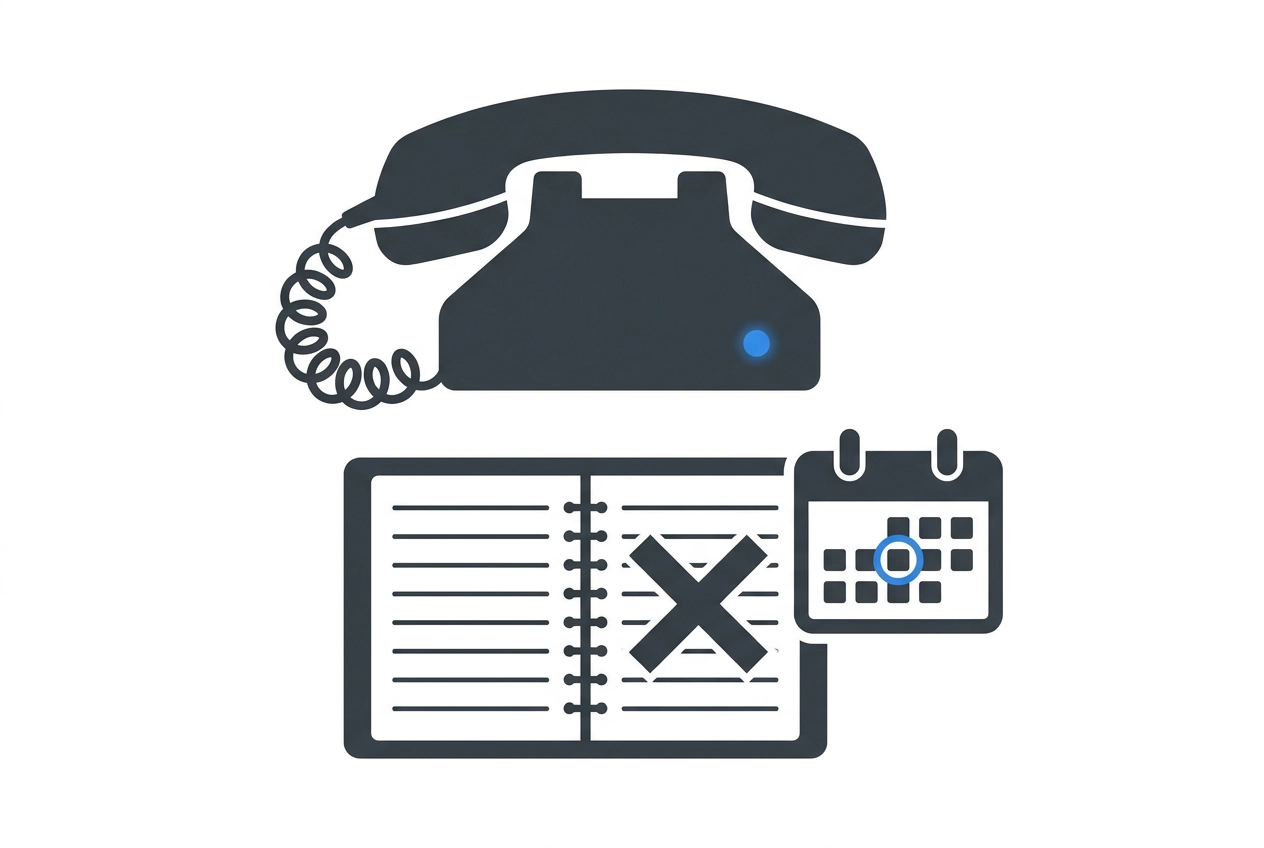
A traditional 24/7 answering service is built to do one thing: ensure a live voice picks up when your team cannot. The operator captures a name, a phone number, and a brief reason for the call, then sends you a message. That is the complete transaction.
The script problem runs deeper than most owners realize. Answering service operators are not trained in plumbing, HVAC, or any home service trade. They work from generic scripts with no framework for asking the questions that actually matter: What type of system do you have? Is water actively leaking? When did the unit stop working? Without those answers, there is no way to distinguish a caller who needs a $150 drain cleaning from one who needs a $4,000 water heater replacement. Your team inherits unqualified messages and has to start the discovery process from scratch.
Booking is not part of what traditional answering services do. The caller is told someone will call them back. Every minute in between is an opportunity for that customer to call your next competitor instead.
There is also no priority intelligence built into the model. An emergency burst pipe at 11 p.m. gets logged exactly the same way as a routine quote request submitted on a Tuesday afternoon. No escalation. No on-call routing. Just a message in a queue.
That is the core limitation: a traditional answering service is a message-taking tool, not a conversion tool. It captures contact information but does nothing to move a caller toward a confirmed job, and the gap between those two outcomes is where revenue quietly disappears.
The Three Gaps That Cost You Jobs
Those message-taking limitations translate directly into three specific conversion failures, each one costing jobs independently and compounding when they operate together.
Gap 1: Lead Qualification
When an answering service captures a name and callback number without asking what's wrong, where the property is, or how urgent the situation is, your team inherits a stack of undifferentiated messages. A routine quote request looks identical to a high-value emergency replacement job. Your technician returns calls in the wrong order, wastes time on poor-fit leads, and may reach a high-value customer hours too late. Research shows 78% of customers buy from the first business to respond. An unqualified message delays that engagement, often fatally.
Gap 2: Appointment Booking
Requiring a callback before anything is scheduled introduces a drop-off window with a measurable cost. A caller who contacted you at 9 p.m. on a Friday has often confirmed a booking elsewhere by the time your office opens Monday morning.
Gap 3: Intelligent Routing
A no-heat call in January and a quote request for a water heater replacement both arrive as messages when an answering service takes them. There is no mechanism to flag the first for immediate on-call escalation. The emergency sits in a queue while your technician sleeps, and the customer calls the next company on their list.
Each gap is a distinct point where a caller who made contact was not converted into a confirmed job. Together, they create a systematic revenue leak worth understanding in full that runs every week, regardless of how consistently the phone gets answered.
Lead Leakage vs. Lead Loss: Understanding the Difference
Those three gaps share a common thread: the call was answered, but the revenue still walked out the door. That distinction has a name, and understanding it changes how you measure your entire call-handling operation.
Lead loss is what happens when a call goes unanswered entirely. The caller hits voicemail, hangs up, and dials a competitor. This is the problem a 24/7 answering service is explicitly designed to prevent, and it does solve it. Answer rates improve. Voicemail drop-offs decrease. On that narrow metric, the service delivers.
Lead leakage is the harder problem. The call is answered, a message is taken, but the interaction never converts the caller into a booked job. Any break in the chain between first contact and confirmed appointment lets the caller move on, and the revenue disappears without ever appearing in your missed-call data.
A business can achieve a 100% answer rate and still hemorrhage revenue through lead leakage. This is precisely the trap that answering-service-only setups create: the visible problem gets fixed, the underlying conversion failure stays invisible.
The metric that surfaces this dynamic is Speed to Lead, defined as the time between a caller's first contact and a confirmed booking. Faster response times correlate directly with higher conversion rates. Callback-dependent models perform poorly here by design; every handoff between the answering service and your team adds friction and time, and each delay widens the window where the caller books someone else.
Answer rate is the wrong benchmark. It measures whether the phone was picked up, not whether the job was won. If you want to quantify what lead leakage is actually costing your business, a revenue leak audit is a practical starting point. The number that predicts revenue is first-contact conversion: how many callers become confirmed jobs without requiring a second interaction.
What Intelligent Call Handling Looks Like in Practice
Closing the Speed to Lead gap requires more than availability, it requires a system that acts on every call, not just answers it.
An AI-powered receptionist like Virtual Dispatcher begins qualifying the caller the moment they connect. It asks targeted questions about service type, property location, urgency, and contact details, capturing everything a dispatcher needs before any human involvement is required. A caller with a failing furnace in January gets asked different questions than someone requesting a routine plumbing estimate, and both interactions are handled accurately and immediately.
Appointment booking happens inside that same call. Rather than taking a message and promising a callback, the system checks real-time availability and confirms the job before the caller hangs up. That single capability eliminates the drop-off window where customers who called after hours or during a busy shift quietly book a competitor instead of waiting for a return call the next morning.
Urgent calls get a separate path entirely. When a caller's responses trigger an emergency flag, an active water leak, a no-heat situation, a failed AC at the height of summer, the system escalates automatically to an on-call technician. Routine inquiries are scheduled without touching your team at all. The result is appropriate triage on every call, with no manual sorting required.
For home service businesses ready to stop losing calls, the practical outcome is measurable: the lead leakage that answering-service-only setups generate systematically becomes a closed gap rather than an ongoing cost.
Calculating What the Gap Actually Costs Your Business
Understanding the scale of that revenue exposure requires nothing more than three numbers you already have.
Start with your average job value. For plumbing and HVAC businesses, that typically falls between $300 and $1,500 per visit. Pick a conservative midpoint for your trade. Next, pull your average monthly inbound call volume. Finally, apply the industry miss rate of 26% to estimate how many of those calls are being lost or mishandled before any conversion can happen.
The math is straightforward. A business receiving 200 calls per month at a $600 average job value is looking at roughly 52 missed or mishandled calls per month. At $600 each, that is approximately $31,200 in at-risk revenue every single month, before a single lead leakage factor enters the calculation.
Layer in what happens to answered calls that still require a callback: with 85% of unanswered callers unwilling to retry, even a short delay between message-taking and follow-up quietly drains jobs that were never counted as missed calls.
Combined, these failure points can put a significant share of your potential monthly revenue at risk, not from neglect, but from a call-handling structure that was never designed to convert.
The cost of intelligent call handling is a fraction of that exposure. Once the revenue at risk is expressed in actual dollars rather than abstract percentages, the return on investment becomes self-evident.
Run this calculation using your own call volume and job values. If you are ready to stop losing calls, start by quantifying exactly what the current gap is costing you. That number makes the decision obvious.
Availability Is the Floor, Not the Ceiling

Once you've run the numbers, one conclusion becomes unavoidable: answering the phone is a starting point, not a strategy.
Availability gets the conversation started; it does not close it. What separates high-converting operations is what happens in the sixty seconds after the call connects: qualifying the lead, booking the appointment, and escalating emergencies without any manual intervention.
Run this audit on your current setup before drawing conclusions:
What percentage of your inbound calls result in a booked appointment at first contact, without a callback?
How quickly does your team follow up on after-hours messages, and what share of those callers are still reachable?
How are urgent calls, an active water leak or a no-heat situation in January, escalated after hours without a human in the loop?
If any of those benchmarks are weak, the problem is not agent performance. It is structural. Traditional answering services were built to take messages, not to qualify, book, or route. Expecting them to close jobs is asking the wrong tool to do the wrong job.
That structural gap is exactly what Virtual Dispatcher is built to close. It qualifies leads, confirms appointments, and routes urgent calls automatically, turning answered calls into booked jobs without additional staff or manual follow-up. If you're ready to stop losing calls, the lever is not more availability. It is smarter handling from the first second of every call.
Conclusion

Availability alone does not win jobs. What actually drives revenue is what happens the moment a call connects: whether the lead gets qualified, whether the appointment gets booked, and whether emergencies get escalated without waiting on a human to intervene.
Traditional answering services were designed for message-taking, not conversion. That structural mismatch creates real, measurable leakage across every shift, every weekend, and every holiday. The businesses closing the most inbound leads have closed that gap with intelligent call handling built specifically for home services.
The opportunity is sitting in your call data right now. Run the audit, measure your first-contact booking rate, and take an honest look at your after-hours follow-up speed. If the numbers are weak, the fix is not more staff. It is smarter systems. Start there, and the revenue follows.